
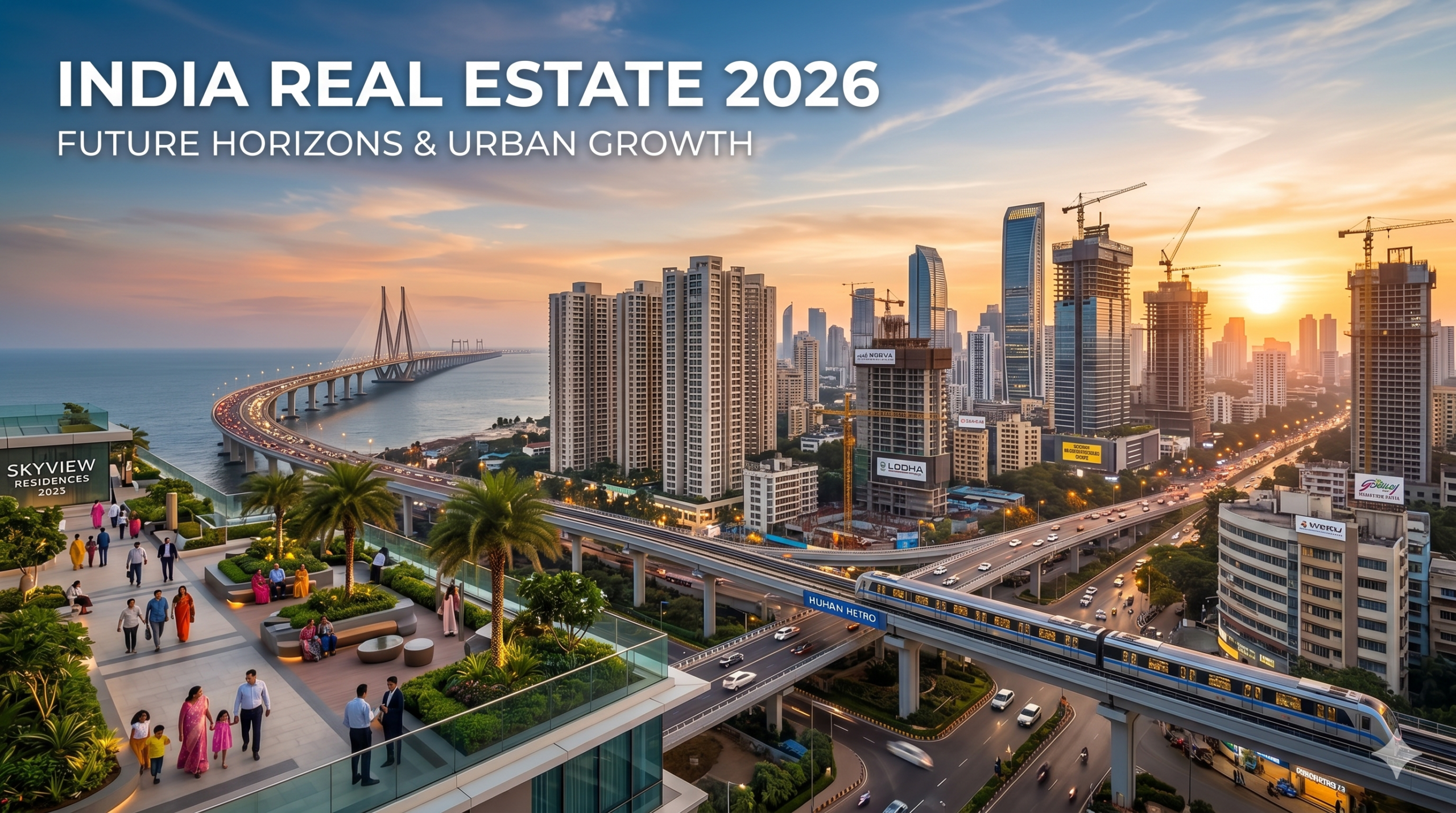
India Real Estate 2026:
7 Explosive Trends You Can’t Afford to Miss
From ₹7% home loans to 15% corridor appreciation — the data, the hotspots, and the insider moves that separate smart investors from the rest right now.
Here’s a number that should grab your attention: India’s real estate sector logged approximately $1.7 billion in transaction activity in the very first quarter of 2026. That’s not the full year — that’s just January to March. And it marks the highest first-quarter institutional deployment since 2021.
The market isn’t just recovering. It’s restructuring. New buyer profiles, new asset classes, new city corridors, and historically low borrowing costs are creating a confluence of opportunity that property watchers haven’t seen in years.
Whether you’re a first-time homebuyer, a seasoned investor eyeing REITs, or a developer deciding where to launch next — here are the 7 defining trends reshaping India’s real estate landscape in 2026.
01 — It’s Officially a Sellers’ Market: Prices Are Climbing Fast
India’s housing market has tipped decisively in favour of sellers. Last year, both new launches and sales exceeded 270,000 units, while unsold inventory contracted to just 10% — the lowest overhang since 2019. The inventory cycle, which stood at 3.5–4.0 years in 2021, has now compressed to a lean 1.2–1.5 years.
📉 Inventory Overhang (Years) — 2021 to 2026
Source: CBRE India Residential Market Outlook 2026
The Reserve Bank of India’s All-India House Price Index rose 3.58% year-on-year in Q3 FY2025–26. At the city level, NCR, Bengaluru, and Hyderabad are seeing even sharper climbs.
| Price Segment | Market Share 2021 | Market Share 2025 | Trend |
|---|---|---|---|
| Below ₹50 Lakh | 42% | 28% | ↘ Shrinking |
| ₹50L – ₹1.25 Crore | 47% | 45% | → Stable |
| ₹1.25 Cr – ₹2 Crore | 11% | 27% | ↑ Surging |
| Above ₹2 Crore (Luxury) | Minimal | Growing fast | ↑ Rising |
02 — Home Loans Hit 7%: The Best Borrowing Window in 4 Years
With the RBI’s repo rate cuts flowing through to the lending market, best-in-class home loan rates are now approaching 7% — the lowest level since 2022. Household incomes are projected to grow 8–10% in 2026, improving affordability significantly.
📊 Home Loan Interest Rate Trend — 2021 to 2026
Source: RBI, Clear Fintech, Global Property Guide 2026
| Bank / Lender | Starting Rate | Max Rate | Best For |
|---|---|---|---|
| SBI | 7.10% | 9.65% | Salaried, govt employees |
| HDFC Bank | 7.20% | 10.10% | Premium borrowers |
| ICICI Bank | 7.20% | 10.05% | Self-employed + salaried |
| Kotak Mahindra | 7.25% | 9.85% | High-value loans |
| Axis Bank | 7.30% | 10.20% | Balanced profile |
| NBFCs / HFCs | 8.50% | 12.50% | Self-employed, smaller cities |
03 — The Office Space Supercycle: 70 Million Sq Ft and Climbing
India’s commercial real estate is in the midst of a demand supercycle. Grade A office space demand is on track to touch 70 million sq ft by year-end — with office vacancy across the top 8 cities dropping to just 13.85% in Q1 2026.
🏢 Office Space — Demand vs New Supply (Million Sq Ft), 2022–2026
Source: Colliers India Real Estate 2026, Cushman & Wakefield
| City | Vacancy Rate | YoY Change | Rent Trend |
|---|---|---|---|
| Bengaluru | 11.2% | ↓ -2.1% | ↑ Rising |
| Hyderabad | 12.8% | ↓ -1.8% | ↑ Rising |
| Pune | 13.4% | ↓ -1.5% | ↑ Steady Rise |
| Mumbai | 14.6% | ↓ -1.2% | → Stable |
| NCR (Delhi) | 15.1% | ↓ -2.4% | ↑ Rising |
| Chennai | 16.3% | ↓ -0.9% | → Stable |
| Kolkata | 18.5% | ↓ -0.5% | → Flat |
| Pan-India Avg | 13.85% | ↓ -1.91% | ↑ +5–10% |
04 — The GCC Effect: Global Giants Reshaping India’s Office Map
Global Capability Centers now account for nearly 40% of Grade A office space uptake in India — one of the most powerful structural forces in commercial real estate today.
Global multinationals are building or expanding their India operations — creating sustained, long-term demand for premium, tech-enabled workspace. This isn’t a cyclical spike — it’s a structural shift.
🌐 Grade A Office Leasing by Occupier Type — 2026
Source: Colliers India Real Estate 2026
| City | GCC Presence | Key Sectors | Office Impact |
|---|---|---|---|
| Bengaluru | Highest | IT, BFSI, Engineering | 🔥 Very High |
| Hyderabad | Very High | Tech, Pharma, Finance | 🔥 Very High |
| Pune | High | IT, Auto, Manufacturing | 📈 High |
| NCR | High | BFSI, Consulting, Retail | 📈 High |
| Chennai | Growing | Auto, IT, Engineering | ⚡ Growing |
| Mumbai | Moderate | BFSI, Media, Logistics | → Moderate |
05 — Tier-2 Cities Are No Longer Optional: They’re the Growth Story
Infrastructure expansion — metro corridors, ring roads, highway upgrades — is unlocking entirely new micro-markets in tier-2 and peripheral zones. Hyderabad’s new metro Phase 2 corridors are recording 12–15% annual appreciation in areas like Tellapur, Kollur, and Nallagandla.
📈 Annual Property Appreciation by City & Zone — 2026 (%)
Source: Knight Frank, Hyderabad Real Estate Market Q2 2026, Colliers
| Location | Near City | Key Driver | Appreciation | Signal |
|---|---|---|---|---|
| Tellapur / Kollur | Hyderabad | Metro Phase 2 | 12–15% | 🔥 Hot |
| Shadnagar | Hyderabad | RRR + NH-65 | 10–14% | 🔥 Hot |
| Whitefield | Bengaluru | IT Parks + Metro | 9–13% | 🔥 Hot |
| Noida Expressway | NCR | Data Centres + IT | 8–11% | 📈 Rising |
| Hinjewadi Phase 3 | Pune | IT Corridor | 7–10% | 📈 Rising |
| Palava / Navi Mumbai | Mumbai | Infra + Affordability | 6–9% | ⚡ Watch |
06 — REITs Are Democratizing Real Estate — And Outperforming
India’s institutional investment story in 2026 is dominated by domestic capital — for the third consecutive quarter, domestic investors outpaced foreign inflows. Institutional investments hit an all-time high of $7.5 billion in 2025.
💰 Institutional Investment by Asset Class — Q1 2026
Source: Cushman & Wakefield India Capital Markets Q1 2026
| REIT | Focus | Cities | Yield (Approx) | Status |
|---|---|---|---|---|
| Embassy Office Parks | Grade A Office | Bengaluru, Pune, NCR | 6–7% | Listed |
| Mindspace REIT | Office Parks | Hyderabad, Mumbai, Pune | 6–7% | Listed |
| Brookfield India REIT | Grade A Office | NCR, Mumbai, Kolkata | 7–8% | Listed |
| SM-REITs (New 2024–26) | Smaller Assets | Pan India | 7–9% | Emerging |
07 — Luxury Is Being Redefined: Wellness, Green & Experience-Led
HNIs, NRIs, and affluent millennials are no longer buying square footage — they’re buying experiences, wellness, and environmental consciousness. Luxury housing demand is showing matured, disciplined appreciation far from speculative frenzy.
| Buyer Type | Budget | Top Priority | Preferred Cities |
|---|---|---|---|
| HNIs (Local) | ₹5–20 Cr | Location prestige, amenities | Mumbai, NCR, Bengaluru |
| NRIs | ₹3–15 Cr | Return on investment, management | Hyderabad, Bengaluru, Pune |
| Affluent Millennials | ₹1.5–5 Cr | Wellness, tech-integration, community | Bengaluru, Pune, Hyderabad |
| Corporate Buyers | ₹4–10 Cr | Branded residences, concierge | Mumbai, NCR |
📍 City-by-City Investment Snapshot — Where to Bet in 2026
| City | Residential Trend | Commercial Outlook | Appreciation | Home Loan Demand | Signal |
|---|---|---|---|---|---|
| Hyderabad | Villas & plots surging | IT corridor boom | 9–15% | Very High | 🔥 Hot |
| Bengaluru | Premium mid-market surge | GCC + tech demand | 7–12% | Very High | 🔥 Hot |
| Pune | IT workforce demand | Steady absorption | 6–10% | High | 📈 Rising |
| NCR (Delhi) | Luxury resurgence | Data centres + flex | 5–9% | High | 📈 Rising |
| Mumbai | SEZ-led high-end | SEZ leasing surge | 4–8% | Moderate | ⚖️ Stable+ |
| Chennai | Mid-to-premium growth | Diversified base | 5–8% | Moderate | 📈 Rising |
| Kolkata | Affordable demand | Logistics growth | 3–6% | Moderate | → Stable |
⚡ 5 Power Moves for Buyers & Investors in 2026
-
1Lock in your home loan now
At ~7%, rates are at a 4-year low. Even a 0.5% rate rise translates to lakhs over a 20-year tenure. Secure pre-approval before the window closes.
-
2Follow the metro map
Infrastructure corridors — new metro lines, ring roads — are the single best leading indicator of appreciation. Buy 1–2 years before the ribbon-cutting ceremony.
-
3Consider REITs if direct purchase feels heavy
SM-REITs and listed REITs offer commercial real estate exposure with full liquidity, professional management, and regulated disclosures.
-
4Target GCC zip codes
Micro-markets around Global Capability Centers — tech parks in Bengaluru, Hyderabad, and Pune — command premium rentals and strong capital appreciation cycles.
-
5Always verify RERA registration
Never commit capital to any project without verifying RERA registration, timeline history, and developer track record. No exceptions.
❓ Frequently Asked Questions
The Bottom Line: Act With Clarity, Not FOMO
India’s real estate market in 2026 is not a bubble — it’s a structural realignment. $1.7 billion in institutional capital in just one quarter. Office vacancy tightening every quarter. Home loans at their lowest in four years. GCCs reshaping entire city districts.
The opportunity is real. But so is the need for due diligence. Choose the right city, the right micro-market, the right asset class — and you’re looking at one of the most compelling property investment environments India has seen in a decade.
2026 rewards those who move with data, not just sentiment.
I

